
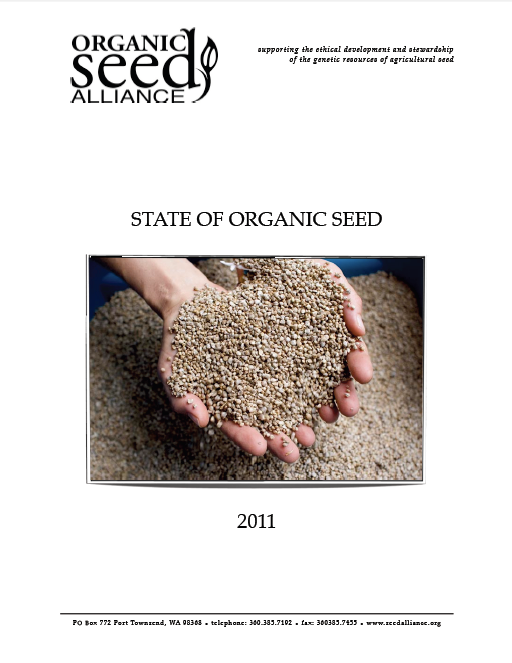
A new publication on the State of Organic Seed is now available from the Organic Seed Alliance. The overall purpose of the SOS is to increase success and minimize risks for the organic farming and food sector by advancing the viability and integrity of organic seed systems. 
Also check out their Seed Saving Guide for Gardeners and Farmers
Learn how to plant the best varieties, maintain your crop “genetics”, cultivate, harvest, process and store seed.
Plus a crop specific chart and resources for gaining more seed growing knowledge.


2 Responses
September 13th, 2011 at 12:03 am
[...] Site Search Blogpost Archives: Posts by month September 2011 August 2011 July 2011 June 2011 May 2011 April 2011 March 2011 February 2011 January 2011 December 2010 November 2010 October 2010 September 2010 August 2010 July 2010 June 2010 May 2010 April 2010 March 2010 February 2010 January 2010 December 2009 November 2009 October 2009 September 2009 August 2009 July 2009 June 2009 May 2009 April 2009 March 2009 February 2009 January 2009 December 2008 November 2008 October 2008 September 2008 Get RSS Feed: Become a Fan: Sites We Like:A Growing Cultureall about Jane's RanchAmerican Livestock Breeds ConservancyCivil EatsCrooked Face CreameryFarm Veteran CoalitionFlower Photos/InfoFriend of the FarmerFunny FarmGardening HelpGreenhorns BlogLittle Seed FarmMama's Worm CompostingMichigan Young Farmer CoalitionNatural Grass SeedOrganic To BePick Your OwnPopcorn HomesteadSimple Good and TastyStart FarmingSustainable Food JobsTakeMeFarminguBuilder Plans (Urban Homesteading)Worm Power google_ad_client = "pub-6603584447124816"; /* 160×600, created 2/2/11 */ google_ad_slot = "4981112554"; google_ad_width = 160; google_ad_height = 600; Survival Seed Bank: Guest Article: Collected Seed Farm – A Source for GMO Free Open Pollinated Organic Heirloom Vegetable Seeds 29Jan Categories: Ag Products, Business, csa, Farming Resources, Marketing, Organic, Seeds Click to Commentgoogle_ad_client = "ca-pub-6603584447124816"; /* Seeds Ad */ google_ad_slot = "6362917402"; google_ad_width = 468; google_ad_height = 60; Collected Seed: GMO Free, Open Pollinated Organic Heirloom Vegetable SeedsSo apparently these folks have disappeared. The link in the original post goes to a Chinese Website. But the pictures are beautiful so I’m keeping the post up.And luckily I’ve put together a comprehensive list of organic, heirloom, non-gmo, seed sources, so check it out at: http://www.beginningfarmers.org/organic-seed-sources/BE SURE TO CHECK OUT THESE GREAT POSTS TOO:http://beginningfarmers.org/state-of-organic-seed-report-and-seed-saving-guide/http://beginningfarmers.org/seeds-finding-choosing-ordering-saving-planting-heirloom-organic-open-pollinated-non-gmo-varieties/Know Your SeedsOver the past century, the majority of the population has completely lost touch with the origin of their food. If the saying you are what you eat is true, what does that say about our sense of self? Our sense of each other? As a lifelong gardener, I have found that growing your own food will not only lead you towards a healthier body, but a healthier spirit. I learn many new and profound lessons in my garden daily.My friends and I came up with the idea to open this farm somewhere along the way between a memory and a dream. We knew that over 80% of farmers in this country were over the age of 55 and asked the question, who will feed us over the next decade? I have been saving and collecting seeds as a hobby with my grandfather in Bulgaria since I was 10 years old. I’m 24 now and a handful of those crops are growing on our farm in upstate New York today.Last year, the volatile stock market boosted garden seed sales 400% — when I watched my parents’ investments in those big companies falter the way they did, I felt good about having stock in something that has an inherent and indisputable value: heirloom seeds. I also felt great about contributing to the “small economy” in such a way where I was offering my customers an affordable (but indispensably valuable) product. And what I’ve learned from experience, you don’t need that many seeds to feed yourself, your family or your entire CSA… if you buy the right kind of seed, of course.Many of the varieties sold through larger seed distributors are GMO and not open-pollinated. This means that they will produce a sterile fruit and you will need to repurchase those seeds again next year rather than save your own year after year. Many of those varieties are also under the litigious guise of Monsanto – the seed industry’s token “Eye of Soron” – which could pose trouble for your neighbors’ seed saving efforts as well.We have collected the best, most resilient open pollinated organic vegetable seeds on the market (many of which I have grown myself), all of which are available through our website. We were very careful with our choice of the highest quality seed inventory because we know that gardeners and beginning farmers all across the country deserve the peace of mind that their labor will be fruitful for them.Collected Seed Farm in Preston Hollow, NYTags: discount, gmo free, Heirloom, highest quality, open pollinated, order, Organic, vegetable seeds, Website Leave a Comment Name Mail (will not be published) WebsitePlease note: Comment moderation is enabled and may delay your comment. There is no need to resubmit your comment. Plugin by wpburn.com wordpress themes google_ad_client = "ca-pub-6603584447124816"; /* Leaderboard */ google_ad_slot = "8216762992"; google_ad_width = 728; google_ad_height = 90; © 2011 Taylor Reid. Site design by Taylor Reid, Lisa Eldred, and Chris Decker. Modified from WordPress Theme Floristica. All Rights Reserved. This website has been made possible through generous contributions from the C.S. Mott Group for Sustainable Food Systems, Josh Warren, William Thacker, P&C Reid, Lola Reid, and others. Entries RSS Login var sc_project=4726988; var sc_security="f27cc5d3"; Page optimized by WP Minify WordPress Plugin [...]
September 16th, 2011 at 2:32 am
Thanks for sharing your story and for protecting out shared agricultural heritage. It’s one of the most valuable and under-appreciated resources we have.
Leave a Comment